Guide
Bringing a car from Norway to Lithuania: customs duty, VAT and registration
Buying a car in Norway or moving back to Lithuania? We explain which taxes are paid, how registration at Regitra works and whether part of the Norwegian tax can be refunded.
In short
When importing a car from Norway to Lithuania, a 10% EU customs duty (unless EU origin is proven) and 21% VAT are paid, and at registration in Regitra – a registration tax for cars with CO2 above 130 g/km. When moving back to live in Lithuania, duty and VAT may be waived. In Norway, part of the engangsavgift can be refunded for cars under 10 years old.
Updated: 6 October 2026
Which taxes are paid on a car from Norway?
Norway is not an EU member, so a car from Norway is imported as from a third country (European Commission):
- Customs duty – 10% for passenger cars (the standard EU rate). If the car was made in the EU or EEA and a proof of origin (EUR.1) is provided, the duty may be 0% (toll.no).
- VAT – 21%, calculated on the value including duty.
- Registration tax at Regitra if CO2 emissions exceed 130 g/km.
It is advisable to check the exact duty rate for a specific car in the customs tariff system (TARIC / LITAR) or with a customs broker.
Moving back to Lithuania? Duty and VAT may be waived
When changing residence, a car can be imported free of duty and VAT if (Lithuanian Customs):
- you lived outside the EU for at least 12 months;
- you used the car for at least 6 months before moving;
- you import it within 12 months of settling in Lithuania;
- you don’t sell, rent out or pledge it for 12 months.
You will need proof: a work or rental contract, a declaration of residence and proof of using the car. The registration tax still applies.
Registration tax in 2026
The tax applies to M1 and N1 vehicles with CO2 emissions above 130 g/km and is paid at Regitra during registration (Regitra). Examples after the January 2026 indexation:
- petrol, 131–140 g/km – €21.63;
- petrol, 171–180 g/km – €108.15;
- petrol, over 300 g/km – €389.34;
- diesel – twice as much (e.g. €43.26, €216.30 and €778.68).
Registration at Regitra: steps
- Pay customs duty and VAT (or arrange the relief).
- Declare ownership with the owner declaration code (SDK).
- Pass the roadworthiness test and buy compulsory insurance.
- Register the car at Regitra – bring the car, your ID and the Norwegian registration document (Regitra).
From 1 October 2026, cars registered in the EEA or Switzerland without EU or Lithuanian type approval, first registered on or after 5 September 2020 (or 2021 and newer models), need a technical expert assessment certificate.
The Norwegian side: export declaration and tax refund
If the car is worth more than NOK 5,000, an export declaration is required. It must be certified at the border at the time of export – this cannot be done afterwards (toll.no). Bring both parts of the vognkort, your ID and an invoice or valuation.
Part of the engangsavgift paid can be refunded for an exported car if (Skatteetaten):
- the car was first registered in Norway on or after 26 June 2014;
- it is less than 10 years old and has a valid EU-kontroll;
- it has been deregistered;
- the refund is at least NOK 7,500;
- you apply within 1 year of export.
VAT is not refunded. The car can be deregistered free of charge via Statens vegvesen “Din side”.
This guide is general information, not legal advice. Customs and tax rules change, so check the official sources listed before sending, or call us.
Car transport with NORVID
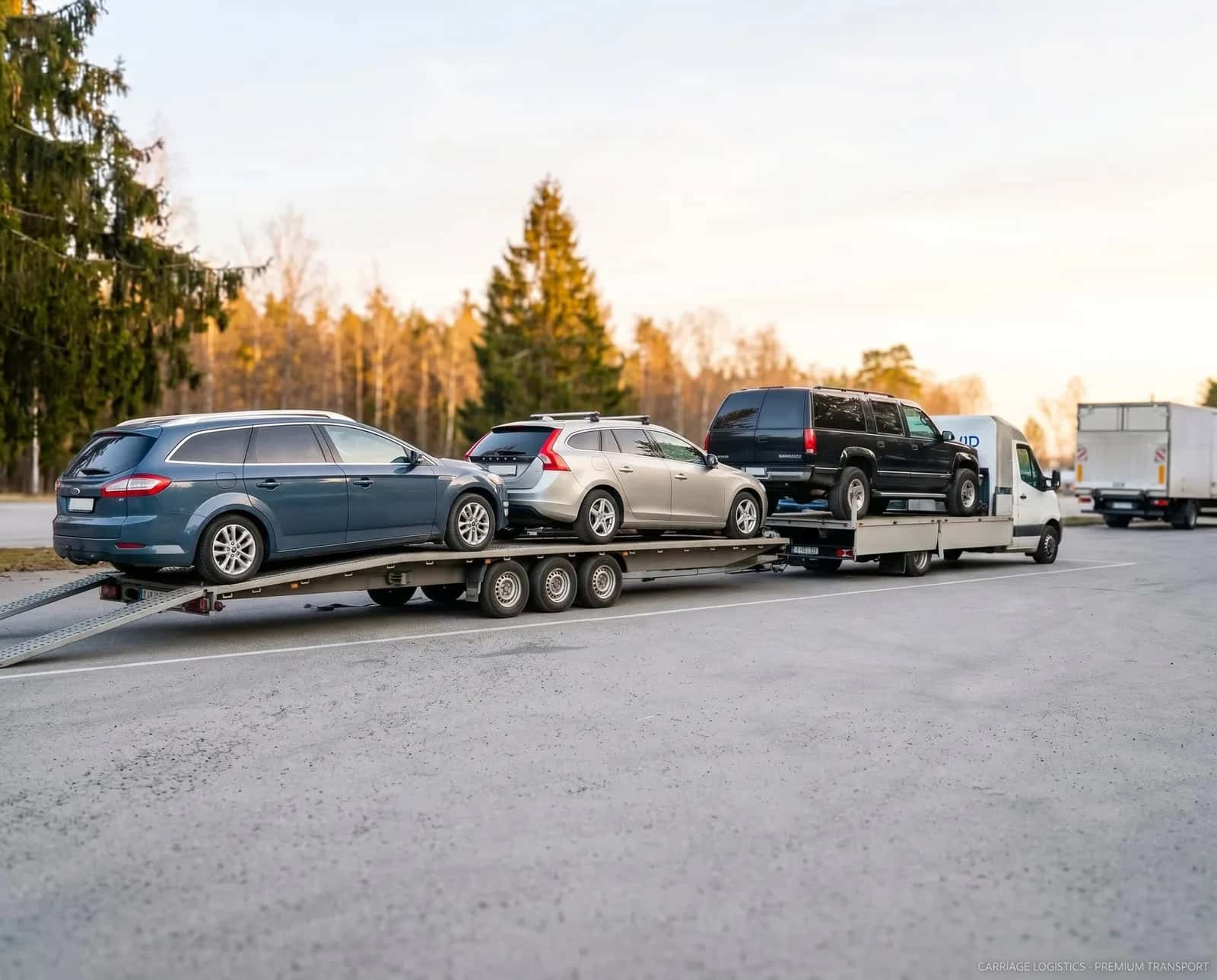
We collect the car at your address in Southern Norway and deliver it on a car transporter to your door in Lithuania. More: Car transport from Norway.
Frequently asked questions
All questions and answersWhat taxes apply to a car from Norway?
Usually 10% customs duty (unless EU origin is proven), 21% VAT on the value plus duty, and the registration tax at Regitra if CO2 exceeds 130 g/km.
I am moving back to Lithuania after years in Norway – do I pay duty?
No duty or VAT if you lived in Norway for at least 12 months, used the car for at least 6 months and import it within 12 months. The registration tax still applies.
Can I get the Norwegian tax back?
Part of the engangsavgift – yes, if the car is under 10 years old, deregistered, the export declaration is certified at the border and the refund is at least NOK 7,500.
Will I need a technical expert assessment at Regitra?
Only if the car has no EU or Lithuanian type approval and was first registered on or after 5 September 2020 (or is a 2021 or newer model) – the rule applies from 1 October 2026.
Should I remove the Norwegian plates before export?
You can export the car on Norwegian plates, but deregister it as soon as possible to stop insurance and the traffic insurance tax.
Do you transport non-running cars?
Yes – we have the equipment to load and transport both running and non-running cars.
How do I prepare the car for transport?
We recommend leaving no more than ¼ tank of fuel and removing personal belongings. We will give exact instructions when you contact us.
How much does car transport cost?
Car transport between Lithuania and Norway costs from 700 € / 7,700 NOK in either direction. The exact price depends on the size and condition of the car and the pick-up location.
Price request
Get a price quote
Takes about a minute. We reply as soon as possible.
Step 2 of 4
Route and date
More guides
GuidesRegistering a car in Norway
When importing a car into Norway, it is declared to customs and 25% VAT is paid. Then a technical approval is done at Statens vegvesen, and the one-off registration tax (engangsavgift) and NOK 2,400 scrap deposit tax (vrakpantavgift) are paid. In 2026, VAT on electric cars applies only to the value above NOK 300,000.
Updated: 6 October 2026Read the guideCustoms and VAT on parcels to Norway
A gift to Norway is free of duty and VAT if it is worth no more than NOK 1,000 per recipient and is sent between private persons. Above that, the recipient pays 25% VAT on the full value. Tobacco and nicotine products cannot be sent from 2026. A gift from Norway to Lithuania is tax-free up to €45.
Updated: 6 October 2026Read the guideWhat can you send to Norway
You can send clothing, belongings and most EU-made food for personal use to Norway. Prohibited: tobacco and nicotine products, drinks stronger than 60%, illegal weapons and fireworks without approval. Sending medicines by parcel is not recommended, and plants need a phytosanitary certificate.
Updated: 6 October 2026Read the guide
Any questions?
Call us or send a request – we will reply with an exact price.